
 3,133 views
ABOUT THIS CONTENT
Summarized notes from the textbook The Economics of Money, Banking and Financial Markets by Frederic S. MishkinSource: These notes are drawn heavily from The Economics of Money, Banking and Financial Markets by Frederic S. Mishkin
Aggregate Price Level (P) – average price of goods and services in the economy measured by CPI or GNP Deflator
Real GNP – uses constant prices (1982)
Nominal GNP – uses current prices
GDP – market value of all final goods and services produced in a country for a given time period (excludes earnings by U.S. individuals and corporations abroad; includes domestic earnings by foreign corporations)
PPI – Producers Price Index – made up of 2800 commodities (no services) at 3 levels: crude materials, intermediate processing, and finished goods – lead indicator of CPI
CPI – market basket of 400 goods and services. Nominal figure with base 1982-4 that includes imports and services but no government purchases or general investing.
Financial intermediaries/markets – address imperfections in markets (risk, liquidity, search costs, economies of scale) and help avoid adverse selection – unequal (asymmetric) info before a transaction; and moral hazard – incentive to one party after the transaction to undermine value to other party.
- M1 – currency, checking accounts and traveler’s checques
- M2 – M1 + extremely liquid assets (e.g. savings, money mkt funds, etc.)
- M3 – M2 + somewhat less liquid assets (RPs, institutional money mkt, etc.)
- L – M3 + short-term securities (T-Bills, commercial paper, etc.)
Reasons for regulation:
- Increase information to investors
- Ensure soundness of financial intermediaries
- Improve monetary control
Asset – store of value; something that will provide future benefits.
Wealth elasticity of (asset) demand = % change demanded / % change in wealth
- Necessity – wealth elasticity < 1 {lower risk or conservative asset}
- Luxury – wealth elasticity > 1 {higher risk or aggressive asset}
Ceteris Paribus – everything else equal.
Fisher Effect – when expected inflation rises, interest rates rise (in=ir + πe)
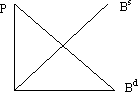
Bonds (classical curve)
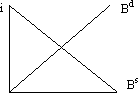
Bonds (as viewed by an individual)
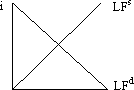
Loanable Funds (as viewed by a corporation)
liquidity preference framework (Keynes) – determines equilibrium i in terms of Money supply and demand
loanable funds framework – determines equilibrium i in terms of supply and demand of bonds
loanable funds framework is easier to use with respect to changes in expected inflation πe; liquidity preference framework is easier to use with respect to changes in income, price level and supply of money.
Keynes – 2 categories of assets people use to store wealth:
- Money
- Bonds
Ms + Bs = wealth ⇒ Bd + Md = wealth ⇒ Ms + Bs = Bd + Md ⇒ Ms – Md = Bd – Bs
* liquidity preference framework ignores effects from changes in expected returns on real assets; Keynes assumed i=0 for money.
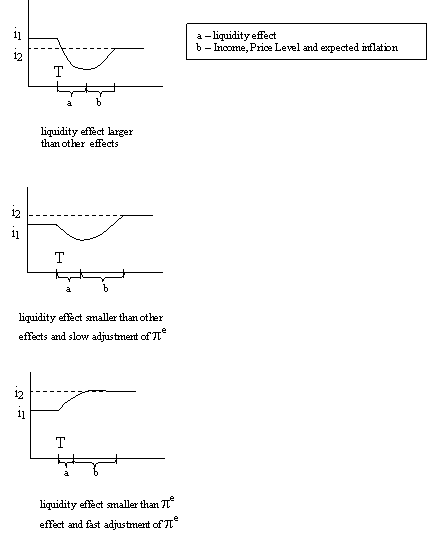
liquidity effect – lowering of interest rate due to increase of Ms (Milton Friedman)
3 reasons people hold money:
- transaction motive = f(y) {y = GNP (income)}
- precautionary motive = f(y)
- speculative motive = f(i)
* A change in price level is an after-the-fact effect not an effect of expectation:
income ↑ ⇒ Price ↑ (employees scarce ⇒ wages ⇒ prices to consumer ↑)
Effects of money on interest rates:
- liquidity effect: Ms ↑ ⇒ i ↓ (spurs economic activity, expansion)
- income effect: Ms ↑ ⇒ income ↑ ⇒ Md ↑⇒ i ↑
- price level effect: Ms ↑ ⇒ P ↑ ⇒ i ↑
- πe effect: Ms ↑ ⇒ πe ↑ ⇒ Bd ↓, Bs ↑ ⇒ i ↑
risk premium – icorp – itreasury
{risk structure – bonds of same maturity; term structure – bonds of diff. maturity}
Factors affecting bond ratings:
- firm’s financial condition
- industry environment
- regulatory constraints
*risk premium reflects corporate bonds lower liquidity in addition to default risk
Term structure facts to be explained:
- interest rates for different maturities move together
- yield curves have steep slope when short rates are low, down slope when short rates are high
- yield curve typically upward sloping
3 theories to explain term structure attributes:
- expectations hypothesis – bonds of different maturities are perfect substitutes, so i for long-term bond = average of short-term rates expected over life of long-term bond.
- segmented markets – bonds of different maturity not perfect substitutes; explains typical upward slope but not other 2 attributes.
- preferred habitat theory – interest rate on long-term bond = average of short-term rates + term premium that responds to demand and supply for that bond
Yield Curves
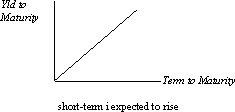
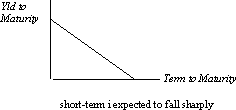
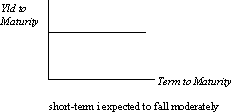
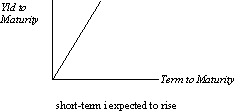
we can use yield curves to tell what the market is predicting for future short-term rates.
Term Structure: Forward Rates
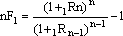
{forward rate = short-term rate for future bond}
Exchange Rates:
A stronger dollar leads to less expensive foreign goods and more expensive U.S. goods exported abroad.
Click to Add the First »