
 1,084 views
ABOUT THIS CONTENT
Benchmarking is the process of measuring performance relative to competitors or other companies and identifying the key business practices which lead to the most productive and effective operations.Benchmarking is the process of measuring performance relative to competitors or other companies and identifying the key business practices which lead to the most productive and effective operations. Traditional benchmarking measures against best direct competitors, whereas “best practice” benchmarking measures against the best across industries. Comprehensive benchmarking compares all processes between competitors, whereas, single-dimensional compares specific areas (e.g., functional, process, issue specific).
Functional benchmarking considers competence/performance in a particular area within an organization.

Process benchmarking compares linkages within the organization.
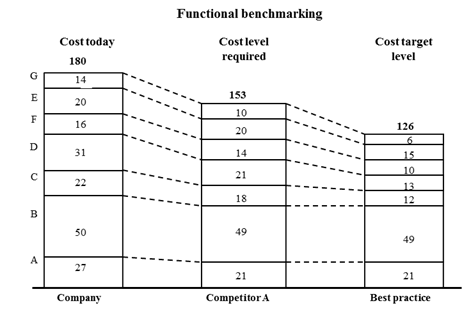
General issue-driven benchmarking considers various items deemed important for comparison.

Methodology
- Determine benchmarking approach and criteria. Choose between dual, traditional, and “best practice” benchmarking. Choose between comprehensive or single-dimensional. For single dimensional, choose between functional, process, or issue-driven benchmarking.
- Gather internal data for comparison. Identify areas under consideration and assemble data from within the organization.
- Identify the benchmarking targets. For traditional benchmarking, identify industry leader(s). For “best practice,” identify issue of interest and choose the leader(s) independent of industry.
- Gather external information. Sources can include: supplier interviews, experts, public databases, internal company databases, financial statements, competitor interviews, and customer surveys
- Analyze data and summarize findings. Choose mode of presentation.
- Derive company specific goals. Define goals with respect to opportunities and threats and the purpose of the organization.
Strengths
- Provides insight and a new perspective towards competitors
- Provides new targets
- Illuminates areas requiring focus as well as new opportunity areas
- Breaks down “arrogance” of companies
Weaknesses
- Difficulties in gathering information, especially external information
- Company can become defensive
- Study can be used as a delaying mechanism
- Comparability of information is a major problem
- Only to be used together with experience and expert interpretation
- Comparing apples to oranges
- Not driven by results
Click to Add the First »