Table of Contents
Segmentation is the process of dividing the overall market along the dimensions that best distinguish customers into groupings, both in terms of behavior and profitability. Segments must meet certain fundamental requirements: relevance, measurability, accessibility, substantiality (in terms of size/profit potential), and durability. Markets can usually be segmented along four generic dimensions: products, customer, geography, and distribution channels. Specific parameters within segments must be determined within the market context and can include: volume levels, price sensitivity, image consciousness, degree of sophistication, integration with other products etc. Selecting the appropriate dimension(s) is the key to successful segmentation.
Methodology
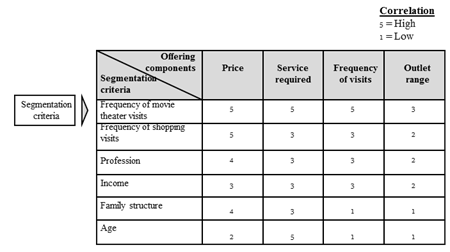
- Define the segmentation criteria. Survey market according to each of the four generic segmentation criteria. Then, determine which other market specific factors might also be valuable for analysis. Ask “What specific criteria about the customer, channel, geography, product, or any combination thereof, best describes/differentiates the market into discernable groups?”
- Identify the segments. Isolate the segments according to generic and market specific dimensions.
- Value the segments. Determine absolute size of each segment and its value in proportion to the overall market, i.e., determine which segments provide disproportionate levels of value. Some segments are usually much more profitable than others.
- Characterize the segments. Characterize the factors that drive the growth of the different segments from a qualitative perspective.


Notes
- Customer needs and preferences can differ significantly in most markets
- Sufficient number of customers are similar enough to constitute a profitable segment of the overall market
- Not something that can only be done on a generic level; it should be performed to capitalize on every market’s unique characteristics
Strengths
- Segmentation aims at properly defining the target market for a company’s strategy
- Segmentation is a major driver of competitive advantage: its application directly shapes strategy
- As market segments evolve over time, segmentation allows a company to step outside today’s business units to take a fresh look at how it serves its customers
Weaknesses
- Viable only if segment is financially worth it and truly homogeneous
- Must have consumer/customer behavior or attitudes at its base. Many segmentations (or markets) are manufacturer myths.
- There is a danger of getting locked into a finite and easily exhausted market. Never lose sight of the “big picture”
- Requires much practice, experience, and effort to perfect